
Manufacturers
Find qualified reps already established with buyers
Reps

Call us and speak with experience.
Most of our board and the MANA staff are made up of working and retired manufacturers and sales reps.
877·626·2776 (U.S. Toll Free) / 949·859·4040
Understanding Manufacturers' Reps

Upcoming Member Events
Manufacturers' Agents National Association
Founded 1947
"I joined MANA six weeks ago and have made contact with several reps and agencies that fit very well into our business."
-Paul Patrash, CEO, Elite Mold & Engineering, Inc.
Member Spotlight




Agency Sales Magazine
A monthly publication since 1949 and an included benefit to your MANA membership.
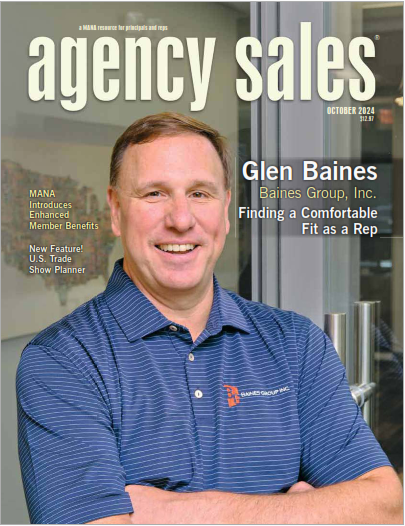
Agency Sales Magazine
Agency Sales Magazine
Audience Profile
- Business Owners
- Manufacturing Executives
- Sales Professionals
- Decision Makers
- Long-term Thinkers
- Ambitious Entrepreneurs
- Honors traditions yet seeks new ideas
- Interests: Sales Processes, Personal Productivity, Manufacturing, Technology, Operational Efficiencies, Return on Investment, Long-Term Partnerships
About MANA
High Quality Reps
Professionalism | Integrity | Ethical
Adaptable | Self-Reliant | Excellence

Award-Winning GCSrep.com
Find Reps
Adaptable | Self-Reliant | Excellence
Award-Winning GCSrep.com
Find Reps